1. What is the First Step in Designing a Clinical Laboratory?
The first step in designing a clinical laboratory is to define the lab's exact purpose, operational scope, and projected sample throughput to inform all subsequent decisions, utilities, and workflow zoning. Every successful lab design begins with clarity. Before drawing a single line, it’s essential to define your laboratory’s purpose and operational scope.
What are the key considerations for a lab's purpose and scope?
Which services will the lab provide (biochemistry, microbiology, molecular diagnostics, pathology)?
What is your projected sample throughput?
How will samples, reagents, and staff move through the space?
The answers inform every decision that follows, influencing space requirements, utilities, and workflow zoning.
2. What Regulatory and Compliance Foundations Must a Lab Meet?
A clinical laboratory must comply with a highly regulated environment by integrating multiple standards like HTM 67 (guidance for healthcare environments) and ISO 15189 (quality and competence requirements) to ensure safety, accuracy, and quality assurance.
Clinical laboratories operate within a highly regulated environment, where safety, accuracy, and quality assurance are paramount.
Designing a compliant laboratory involves understanding and integrating multiple standards and regulatory frameworks that govern everything from building layout to biosafety and environmental control.
Prioritising lab safety through design is simple, if you keep to the following considerations.
What are the essential standards and regulations for clinical labs?
HTM 67: Laboratory fitting-out guidance for healthcare environments
This sets out best practice for the design, fit-out, and specification of laboratories in healthcare settings. It covers spatial planning, ventilation, services, finishes, and infection prevention measures to create safe, functional environments that support effective clinical operations.
ISO 15189: Medical laboratories – Requirements for quality and competence
The international standard for quality management and technical competence in medical laboratories. It ensures all laboratory processes, from sample collection to result reporting, are reliable, traceable, and subject to continual quality improvement. Compliance supports accreditation and underpins patient confidence in laboratory testing.
CLSI GP18-A2: Guidelines for laboratory design and environmental control
Issued by the Clinical and Laboratory Standards Institute, this provides detailed guidance on laboratory design parameters that influence accuracy and safety. It includes recommendations for air handling, biosafety containment, lighting, workflow, and ergonomic layout to reduce risk and enhance performance.
COSHH Regulations (UK): Control of Substances Hazardous to Health
Laboratories must manage hazardous substances safely in line with COSHH. This requires adequate ventilation, appropriate storage facilities, containment systems, and waste disposal procedures. Early design integration of these controls reduces exposure risk and ensures compliance with health and safety law.
Health and Safety at Work Act 1974 and HSE Laboratory Safety Guidance
Employers have a duty to provide a safe working environment. Laboratory design must therefore account for emergency access routes, fire safety measures, clear signage, and safety installations such as fume cupboards, eyewash stations, and emergency showers.
Building Regulations and Fire Safety (Approved Documents B and M)
Compliance with general building and fire safety standards ensures laboratories are structurally sound, accessible, and protected against fire risks. This includes the use of fire-rated materials, compartmentation, and the design of safe egress routes.
Integrating these frameworks at the earliest stages of design ensures that clinical laboratories are compliant, efficient, and ready for accreditation. It reduces the risk of costly modifications post-build, supports staff safety, and upholds the reliability and integrity of diagnostic services.
3. What Infrastructure and Environmental Systems are Critical for a Lab?
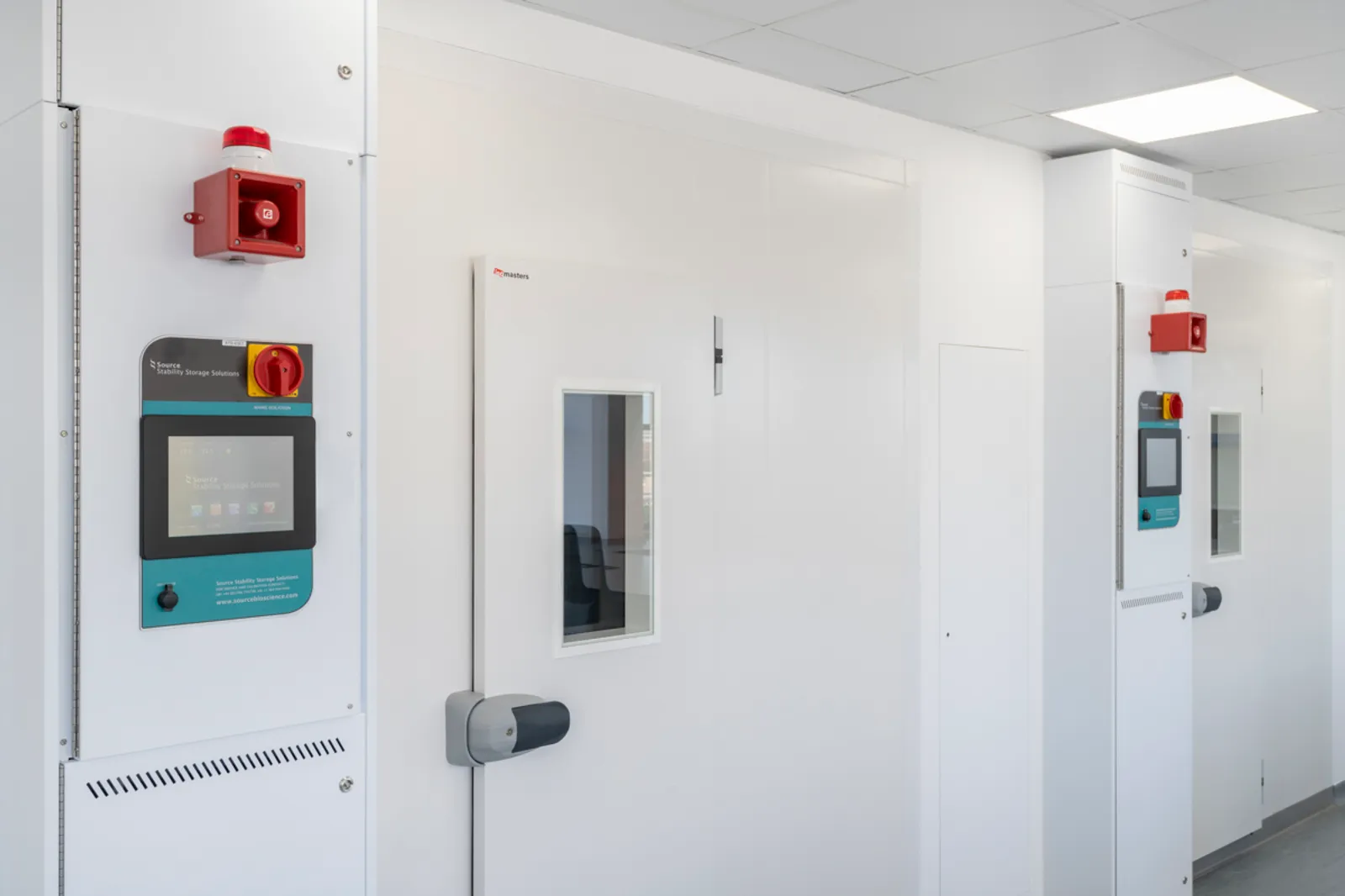
A clinical laboratory’s infrastructure forms the backbone of its safety, functionality, and efficiency. Every mechanical, electrical, and digital system must be designed to support precision, minimise risk, and maintain uninterrupted operation. Effective integration of these systems ensures a stable environment where testing quality and staff wellbeing are never compromised.
HVAC and Airflow Control
Heating, ventilation, and air conditioning systems are critical for maintaining pressure differentials between laboratory zones. Proper airflow design prevents cross-contamination, supports biosafety containment requirements, and ensures thermal comfort. Cleanroom or containment areas may require HEPA filtration, directional airflow, and negative or positive pressure regimes depending on the laboratory’s purpose.
Utilities and Redundancy
Essential services such as gas, water, electricity, and vacuum systems must be reliable and designed with built-in redundancy. Dual supply lines, backup generators, and uninterrupted power systems (UPS) help maintain continuous operation during maintenance or unexpected outages, protecting sensitive equipment and ongoing experiments.
Lighting Design
A layered lighting strategy supports both technical precision and staff wellbeing. Task lighting ensures accurate visual analysis during detailed work, while ambient and natural lighting promote comfort and reduce fatigue. Lighting levels should comply with healthcare illumination standards and be adaptable to different laboratory functions.
Acoustics and Environmental Comfort
Effective sound control improves concentration, communication, and overall comfort within the laboratory. Acoustic treatments and careful equipment placement can help minimise background noise, particularly in open-plan or shared environments.
Digital Connectivity and Data Systems
Robust digital infrastructure is now fundamental to laboratory performance. Structured data cabling, secure network connections, and integration with Laboratory Information Systems (LIS) enable automation, sample tracking, and real-time data sharing. Increasingly, Internet of Things (IoT) integration supports remote monitoring of environmental conditions, equipment status, and energy use.
Maintenance Access and Flexibility
Infrastructure design should also consider ease of access for maintenance and upgrades. Modular service routes and accessible ceiling or floor voids reduce downtime, while flexible system design supports future technological advancements or changes in laboratory function.
Integrating these systems cohesively from the outset creates laboratories that are resilient, compliant, and adaptable, capable of supporting the precise environmental and operational requirements of modern clinical science.
4. How is Safety and Biosafety Integrated into Lab Design?
Safety isn’t an add-on; it’s the foundation of laboratory design.
A clinical laboratory handles biological, chemical, and sometimes radioactive materials, so every design decision must protect the people who work within the space as well as the environment beyond it.
Having a sustainable lab space should not just be a side thought, it should be a priority.
Safety principles should be embedded at every stage of design, from the initial risk assessment to final commissioning, ensuring that compliance and usability go hand in hand. There are many things to think about when designing labs, however the priority should always be safety, here is are the most important considerations.
What are the different Biosafety Levels (BSL 1-3) and containment measures?
Understanding Biosafety Levels (BSL 1–3) is critical to determining how a laboratory is built and operated:
BSL-1: Suitable for work with low-risk agents; requires basic hygiene and PPE, with handwashing stations and restricted access.
BSL-2: For moderate-risk pathogens; requires containment devices such as biological safety cabinets (Class II), negative air pressure, and self-closing doors.
BSL-3: For high-risk airborne pathogens; demands negative-pressure rooms, sealed walls and ceilings, HEPA-filtered exhaust systems, and separate entry/exit airlocks.
Read more about biosafety levels and how to implement them now.

Hazardous Material Management
We design dedicated storage zones for chemicals, biological samples, and flammable substances, equipped with spill containment trays, appropriate ventilation, and access control.
Chemical storage is separated from biological containment areas to reduce cross-contamination risks, and all waste streams are carefully planned for segregation, collection, and disposal in line with COSHH and HTM 67 guidelines.
Waste and Decontamination Areas
Safe waste handling is integral to biosafety. Our laboratories include clearly defined waste routes and decontamination spaces with autoclaves, chemical neutralisation stations, and secure storage for hazardous waste. Effluent systems are designed to prevent the release of harmful agents into local drainage networks.
Emergency Systems and Risk Mitigation
A well-designed laboratory anticipates emergencies before they happen. We integrate a range of emergency systems, including:
Eyewash stations and safety showers located within 10 seconds’ access from any workstation.
Fire suppression systems designed for laboratory environments (e.g., inert gas or dry systems where water may cause damage).
Clearly marked evacuation routes and illuminated signage.
Backup power systems for critical equipment such as freezers and ventilation.
All systems are commissioned and tested to ensure immediate functionality during an incident, and our layouts ensure staff can respond quickly and safely.
Separation of Clean and Dirty Workflows
Maintaining a clear distinction between ‘clean’ and ‘dirty’ workflows is essential. We design unidirectional flow patterns for samples, equipment, and personnel, minimising the risk of cross-contamination.
Designated gowning and de-gowning areas, pass-through cabinets, and airlocks maintain containment integrity between zones.
Staff Training and Safety Culture
A laboratory’s safety doesn’t end with its design. We work with clients to develop training and operational guidelines that embed a safety-first culture.
Proper signage, standard operating procedures (SOPs), and staff orientation programmes ensure the space is used correctly and consistently.
Common Pitfalls to Avoid
Pitfall | Impact | Solution |
Insufficient power or service redundancy | Operational downtime | Design with spare capacity and backup systems |
Overcrowded layouts | Inefficient workflow, safety hazards | Allow 15–20 m² per person and adequate circulation space |
Poor airflow planning | Contamination risk | Implement directional airflow and regular testing |
Ignoring future scalability | Expensive retrofits | Use modular design with expandable infrastructure |
Late integration of safety features | Costly rework | Integrate safety from the design outset |
How Laboratory Design Can Help in a Clinical Laboratory
Effective laboratory design plays a vital role in enabling accuracy, efficiency, and safety within a clinical environment.
A well-planned layout supports streamlined workflows, reduces the risk of contamination, and ensures compliance with regulatory standards.
A thoughtful laboratory fit out or design also improves staff wellbeing, enhances collaboration, and allows for future scalability as testing methods and technologies evolve.
Ready to begin your laboratory design journey? Get in touch with our specialist team now.