The challenge of scaling in biotech
Biotech research laboratories face a unique challenge: they must evolve as rapidly as the science they support. Fast-paced innovation means research demands can shift significantly within short timeframes, creating pressure on physical infrastructure that was perfectly adequate just months earlier. Growth in headcount, the introduction of new equipment, emerging scientific modalities, and increasing regulatory complexity all compound this pressure.
The result? Many biotech laboratories find themselves outgrowing their spaces faster than anticipated, leading to bottlenecks, safety concerns, and operational inefficiencies that can slow critical research.
This article provides a clear, design-led guide to ensuring biotech research labs can scale efficiently and safely, supporting scientific ambition without compromising on workflow, safety, or future flexibility.
Why biotech labs outgrow themselves quickly
The pace of innovation in biotechnology is relentless. A biotech lab designed for early-stage discovery work may need to accommodate cell culture expansion, analytical instrumentation, or automated workflows within a year. Teams grow, equipment lists expand, and research priorities shift as projects progress from concept to preclinical development.
Unlike traditional commercial spaces, biotech labs must balance scientific requirements with stringent environmental controls, biosafety protocols, and regulatory considerations. This complexity means that scaling isn't simply about adding more benches; it requires thoughtful planning across multiple dimensions of laboratory infrastructure.
What does "scaling" mean for biotech laboratories?
Mapping the scientific workflow
Effective scaling begins with a thorough understanding of how science actually happens within your facility. Biotech research typically moves through distinct stages: discovery, development, optimisation, and preclinical testing. Each stage introduces new spatial requirements, equipment needs, and environmental conditions.
Rather than making generic assumptions about what a "biotech lab" should look like, successful laboratory design starts by mapping these workflows in detail. Where do samples move? Which processes require proximity? What are the critical adjacencies that support efficiency?
Anticipating future research directions
Research pipelines evolve constantly. A lab focused on molecular biology today might need to integrate tissue culture capabilities tomorrow, or shift from predominantly bench science to analytical techniques requiring sophisticated instrumentation. Some organisations find themselves moving toward automation as throughput demands increase.
Designing for change rather than static setups is essential. This means thinking beyond current needs to consider plausible future scenarios, not to build everything at once, but to ensure your infrastructure can accommodate evolution without requiring complete reconstruction.
Identifying space types critical for scale
Scalable biotech facilities typically require careful planning around several distinct space types: wet labs for hands-on experimental work, dedicated instrument rooms for sensitive analytical equipment, clean zones for cell culture or sterile processes, write-up areas for data analysis and documentation, cold storage for samples and reagents, and collaboration spaces where teams can discuss results and plan next steps.
Well-planned adjacencies between these zones allow teams to expand while maintaining flow and efficiency. Poor adjacencies, by contrast, create bottlenecks that become increasingly problematic as the organisation grows.

What core design principles enable scalable biotech labs?
Flexibility and modularity
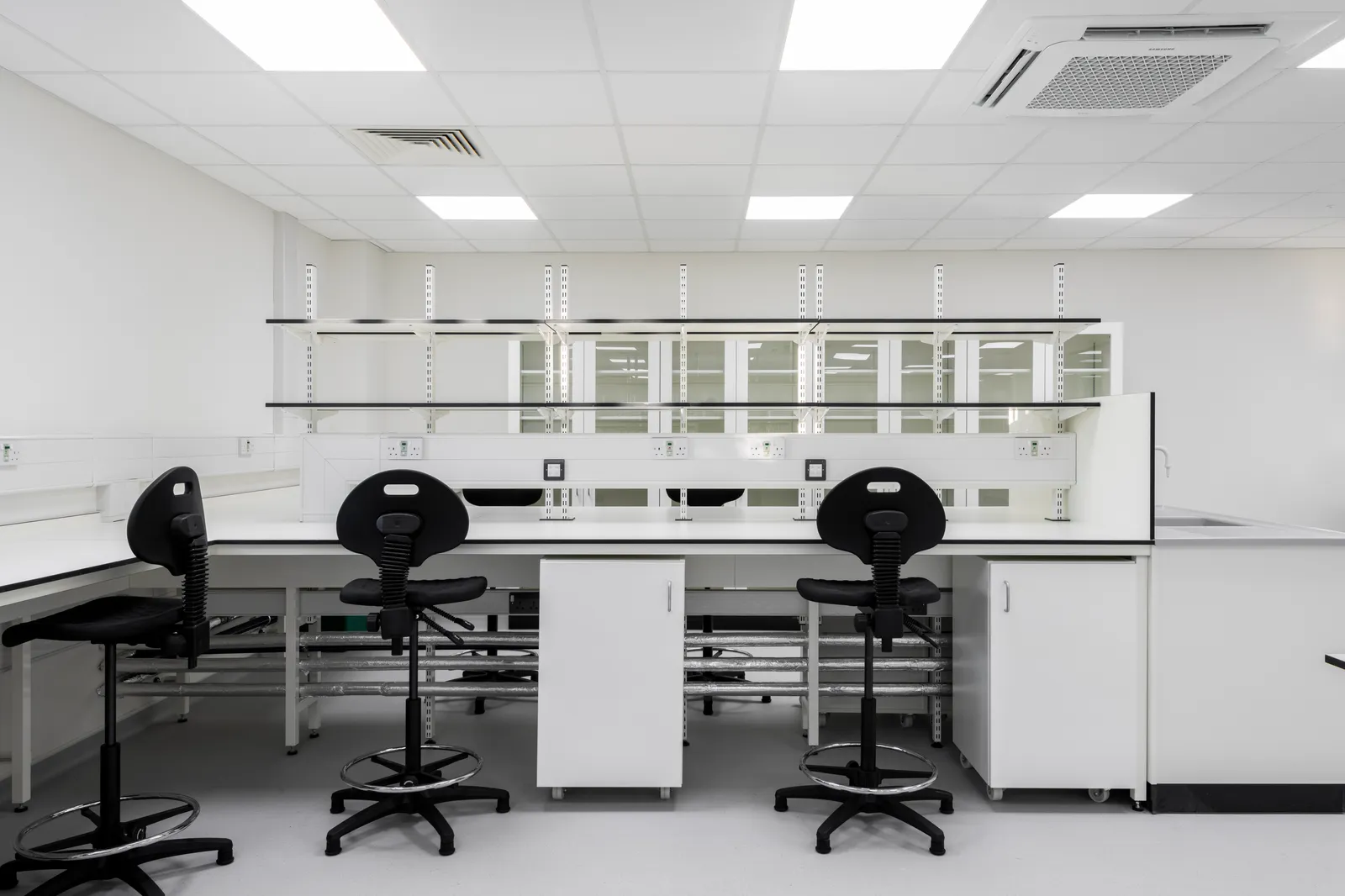
The most scalable laboratories embrace flexibility at every level. Movable benches, reconfigurable casework, adjustable shelving, and modular storage systems dramatically improve adaptability. Rather than being locked into fixed layouts, teams can reorganise spaces as needs evolve without major refurbishment work.
This modular philosophy extends to equipment planning as well. When utilities are accessible and systems are designed with standardised connections, upgrading or replacing instruments becomes straightforward rather than disruptive.
Laboratory furniture choices play a crucial role here, selecting systems that can be reconfigured, expanded, or repurposed ensures your physical infrastructure keeps pace with scientific ambition.
Designing with infrastructure headroom
One of the most common constraints in scaling biotech labs is inadequate infrastructure capacity. Mechanical, electrical, and plumbing systems must account for future requirements: higher power draws as equipment density increases, additional data points for networked instruments, extra gas supplies for new analytical techniques, and more intensive HVAC demands as occupancy and heat loads grow.
Building in excess capacity, typically 20-30% beyond current requirements, helps labs scale without disruptive infrastructure upgrades. This headroom should extend to power distribution, chilled water systems, compressed air, specialist gases, data cabling, and ventilation capacity.
While this approach requires greater upfront investment, it dramatically reduces the cost and disruption of future expansion compared to retrofitting inadequate systems.
Containment and biosafety considerations
As biotech organisations grow, they often increase their risk profiles or introduce higher biosafety processes. A lab that initially worked with BSL1 materials might need to accommodate BSL2 or BSL3 work as research progresses.
Planning early for potential transitions prevents costly structural changes later. This includes maintaining correct pressure regimes between zones, ensuring proper airflow management with adequate air changes per hour, designing decontamination routes, and providing appropriate physical containment where required.
Even if higher biosafety levels aren't immediately necessary, designing spaces that could accommodate them, through appropriate HVAC zoning, suitable finishes, and logical containment boundaries, provides valuable future flexibility.
Efficient movement of people, samples, and materials
Clarity of circulation routes supports both productivity and safety. As teams grow and activity intensifies, poorly planned movement patterns create congestion, increase cross-contamination risks, and frustrate researchers who spend unnecessary time navigating inefficient layouts.
Effective circulation design separates clean and "dirty" flows where appropriate, ensures write-up spaces and collaboration areas sit logically near research zones without bottlenecking movement, and provides adequate corridor widths and clearances for equipment transport.
Which technology and equipment support scale?
Designing labs that are automation-ready
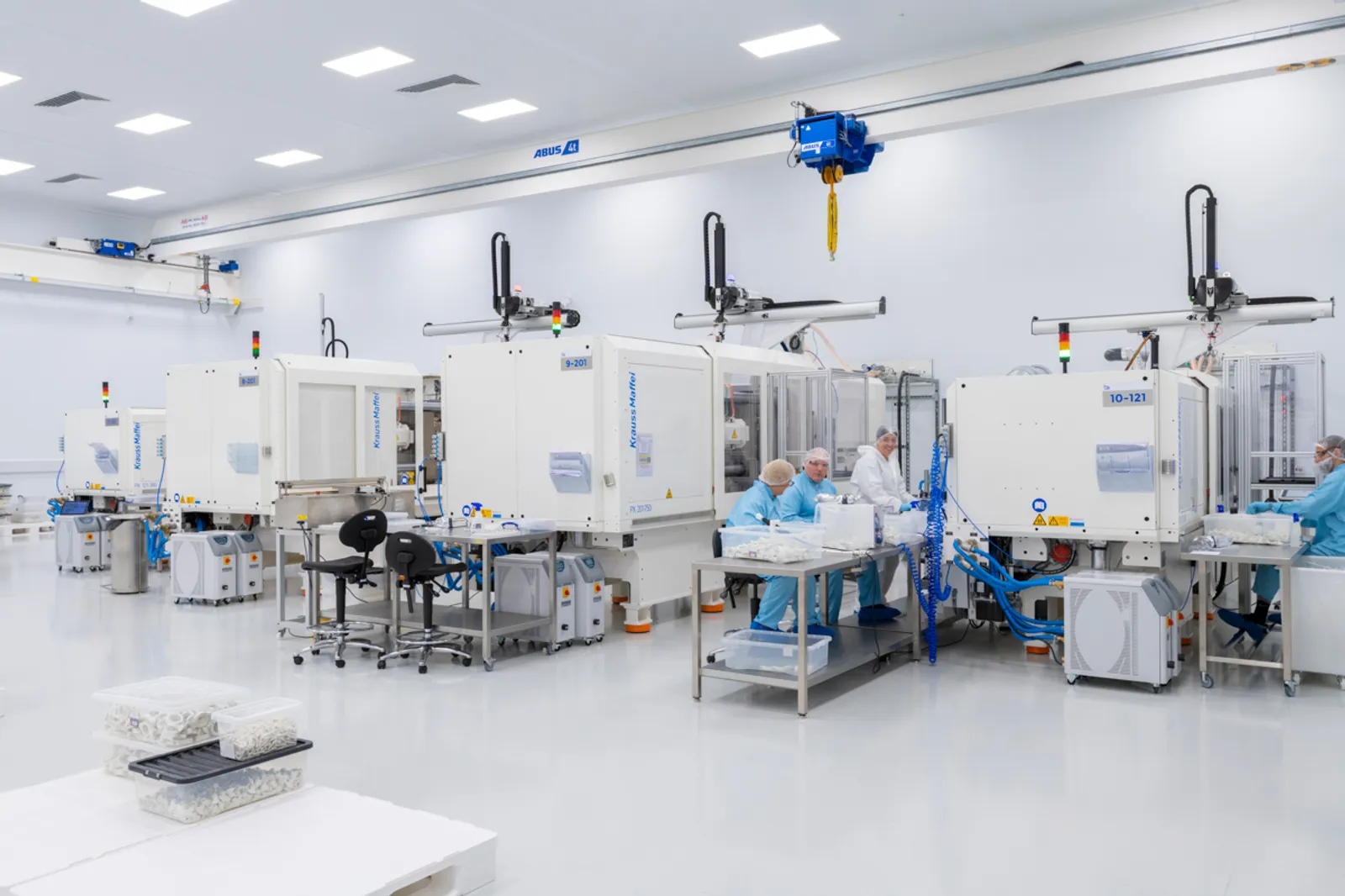
As biotech companies grow, introducing robotics and automated workflows becomes increasingly common. Automation offers consistency, improves throughput, and frees researchers from repetitive tasks, but it introduces specific spatial and infrastructure requirements.
Automated systems need straight-line movement paths, generous clearance zones around equipment, and consistent utility provision. Forward-thinking design ensures these technologies can be added without rebuilding substantial portions of the laboratory.
This doesn't mean every lab needs automation from day one, but considering where automation might logically integrate, and ensuring those areas have appropriate floor loading, power capacity, and spatial clearances, prevents future constraints.
Building a robust digital backbone
Modern biotech research generates vast amounts of data. Instruments communicate with central systems, researchers access cloud-based tools, and facilities increasingly deploy IoT sensors for environmental monitoring and equipment management.
This digital ecosystem requires reliable, high-capacity network infrastructure: comprehensive Wi-Fi coverage, dense data points throughout bench and instrument areas, and future-proof network architecture that can accommodate increasing bandwidth demands.
Digital tools such as Laboratory Information Management Systems (LIMS), Electronic Lab Notebooks (ELN), and real-time monitoring platforms also influence lab layout and equipment placement. Designing with these systems in mind ensures they enhance rather than complicate workflows.
Standardisation for smoother growth
While flexibility is crucial, strategic standardisation also supports scalability. Standardising equipment families, selecting compatible instruments from preferred vendors where possible, simplifies maintenance, streamlines training, and ensures new equipment fits seamlessly into existing layouts and service connections.
Similarly, standardising utility connections, bench heights, and storage systems reduces complexity as the facility grows and makes it easier for staff to work efficiently across different areas.
What strategies will help scale or refurbish an existing biotech lab?
Assess the current constraints
Not every organisation has the luxury of designing a new facility from scratch. Many face the challenge of scaling within existing spaces. The first step is a thorough assessment of current constraints.
This evaluation should examine structural grid and column spacing, floor loading capacity (critical for heavy equipment), HVAC capacity and distribution, current space utilisation and inefficiencies, equipment density and clustering, and existing adjacencies between functional zones.
Understanding where current infrastructure restricts growth allows you to focus on improvements where they'll have the greatest impact.
Reconfiguring space to improve capacity
Often, significant capacity improvements are possible without major construction. Realigning functional zones can reduce bottlenecks or liberate underused areas. Introducing flexible furniture systems, reorganising storage to reclaim floor space, or converting suitable rooms for expanded scientific use can all increase effective capacity.
Laboratory refurbishment focused on improving flow and space utilisation can deliver substantial benefits without the disruption and cost of major structural interventions.
Phased improvements to minimise disruption
For operating biotech labs, maintaining continuity during upgrades is paramount. Breaking refurbishments into manageable, low-impact stages allows research to continue with minimal interruption.
Strategies include using temporary decant labs for displaced teams, scheduling intensive work during planned shutdowns, tackling improvements zone-by-zone rather than facility-wide, and utilising modular and prefabricated elements that reduce on-site construction time.
Experienced construction and fit-out partners can sequence work to minimise operational impact while delivering meaningful improvements.
How to design with future horizons in mind?
Preparing for regulated or GMP-adjacent research
Many biotech organisations eventually adopt GMP (Good Manufacturing Practice) or GMP-adjacent processes as their research moves toward clinical applications. These regulated environments impose strict requirements on space design, environmental controls, documentation, and quality systems.
Planning for this possibility early, even if GMP work isn't immediately on the horizon, can avoid expensive compliance upgrades later. This includes designing spaces with appropriate environmental zoning, specifying finishes suitable for cleanroom environments, ensuring monitoring and control systems can meet documentation requirements, and maintaining clear separation between different process areas.
Building in sustainability for long-term efficiency
Sustainable design isn't just environmentally responsible; it supports long-term operational efficiency and cost stability. Laboratory facilities are energy-intensive, but thoughtful design can substantially reduce their environmental footprint and running costs.
Strategies include efficient HVAC systems with heat recovery, natural lighting in write-up and collaboration spaces, durable, long-lasting materials that reduce replacement cycles, intelligent energy management systems that optimise consumption, and right-sizing equipment to avoid unnecessary oversizing.
Sustainable laboratory design delivers financial benefits alongside environmental ones, improving resilience against energy cost fluctuations.
Creating spaces that support scientific, digital, and organisational evolution
The most successful biotech laboratories remain relevant as science advances. They accommodate new project types, support interdisciplinary collaboration, and integrate emerging tools without requiring fundamental redesign.
This long-term mindset means designing R&D labs that balance specialisation with adaptability, providing the specific conditions today's research requires while maintaining the flexibility to evolve. It means creating environments where teams can collaborate effectively, where digital and physical infrastructure work seamlessly together, and where the facility enhances rather than constrains scientific ambition.
Workplace consultancy can help organisations think strategically about how their laboratory environments support not just current science, but future organisational goals and research directions.
Designing labs that grow with the science
Scalable biotech laboratories balance flexibility with purpose-built functionality, resilience with efficiency, and immediate needs with future readiness. They recognise that research environments must evolve as rapidly as the science they support, and they build this adaptability into every design decision.
Well-considered laboratory design reduces disruption, controls costs, and mitigates risks as organisations grow. It ensures that physical infrastructure enables rather than constrains scientific progress, that teams can expand without compromising safety or efficiency, and that facilities remain relevant as research priorities shift.
The most successful approach combines careful workflow analysis, infrastructure planning with appropriate headroom, modular and flexible systems, strategic standardisation that supports rather than constrains adaptability, and a long-term perspective that anticipates multiple future scenarios.
Whether designing a new facility or refurbishing existing space, thinking systematically about scalability from the outset delivers lasting value, creating laboratories that truly grow with the science they support.